On food, memory and the making of a Foodoir
There are places we forget we have been.
There are years that become blurred at the edges, conversations whose words disappear, faces we can no longer quite picture with certainty. Time has a way of softening the details of our lives until what once felt vivid becomes distant.
And then, unexpectedly, we taste something.
A particular spice hits the tongue. The smell of onions slowly caramelising fills a room. Something crackles in hot oil. We hear the familiar rhythm of a knife against a chopping board.
And suddenly, we are somewhere else.
Not metaphorically.
For a moment, we are there.
We are sitting at a table we have not seen in decades. We are standing in a kitchen that no longer exists. We hear the voice of someone who has long since left our lives. We remember a holiday, a childhood afternoon, a first love, a family celebration or perhaps a difficult period we thought we had buried.
Food has a peculiar relationship with time.
It does not simply remind us of the past.
It can return us to it.
Memory is often thought of as something visual. We remember faces, photographs, landscapes and places. Yet some of our deepest memories are stored somewhere far less obvious. They live in our senses.
A smell.
A taste.
A texture.
A sound.
The warmth of a plate held between our hands.
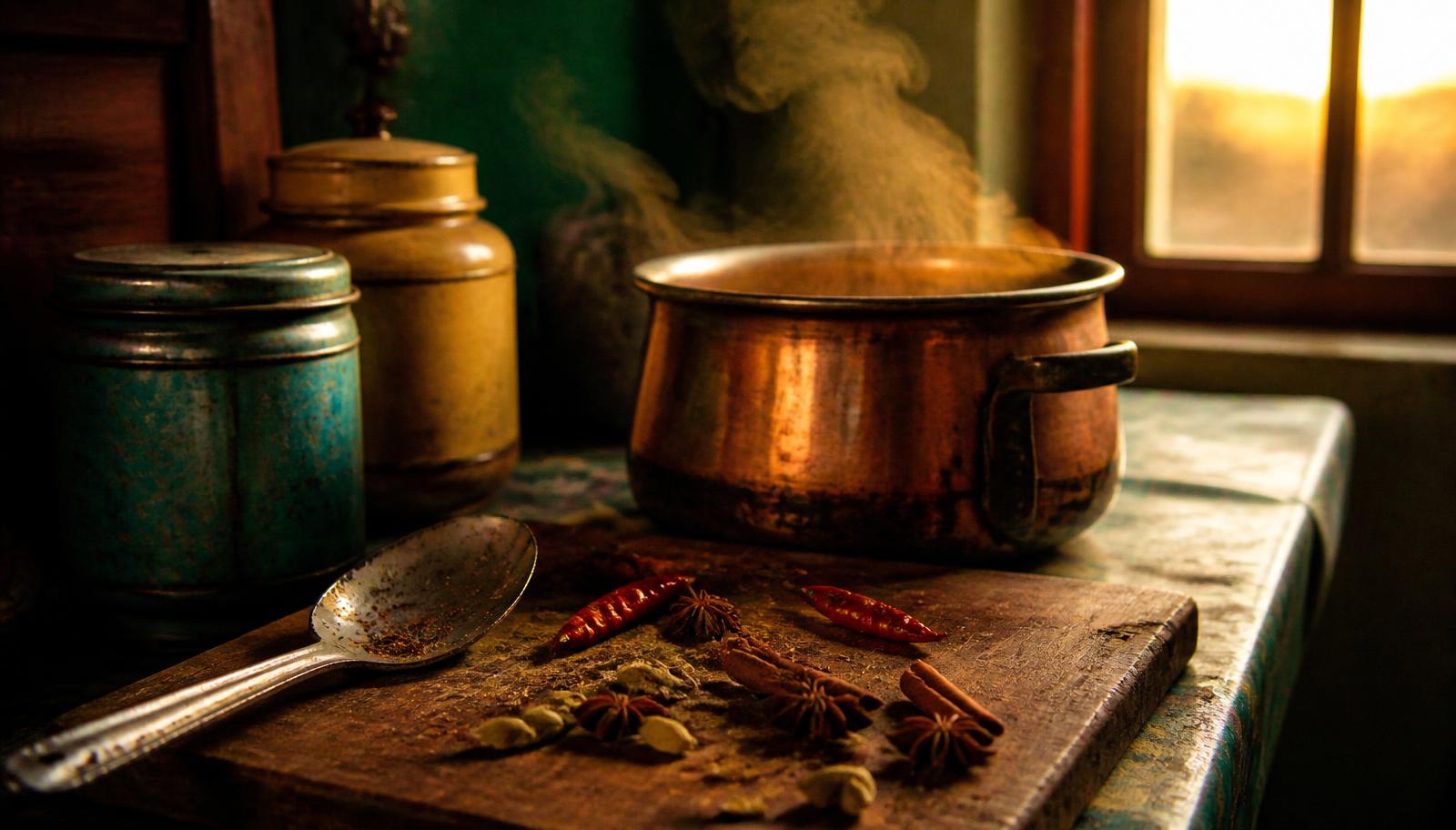
The sensation of steam rising from a pot.
The first bite of something familiar.
Food can unlock all of these doors at once.
Perhaps that is why food and memoir have such a natural and almost symbiotic relationship.
Memoir asks us to remember.
Food gives memory something tangible to hold.
When we write about an event, we reconstruct it through language. When we cook the food associated with that event, we experience it again through the body. The memory becomes more than something we describe. It becomes something we can almost inhabit.
That distinction became fundamental to the creation of The Road to Kali.
I could not separate the food from the life.
The two had been travelling together for as long as I could remember.
Food was there when I was discovering the world.
It was there in childhood, in family kitchens, in celebrations and in the rituals that gave ordinary days meaning. It travelled with me as I grew older, encountered different cultures, travelled to different places and began to understand that food was not simply something we consumed.
It was something we inherited.
Something we created.
Something we shared.
Something we used to communicate.
And sometimes, something we used to survive.
There were moments in my life when food was an expression of love. Someone cooking for you could say what words could not. A meal could become an apology, an invitation, an embrace. Cooking could be an act of care when there was nothing else you knew how to give.
There were moments when food brought comfort.
There were moments when it became discovery.
There were moments when it became creativity.
There were moments when it became celebration.
There were moments when it became prayer.
And there were moments when it simply became a reason to keep moving.
Looking back, I realised something rather extraordinary.
Food had been present for almost everything.
It was never merely sitting in the background of my life.
It was there.
Always.
Almost omnipresent.
And perhaps that is why, when I began writing my story, food refused to become a supporting character.
It wanted a larger role.
It became the protagonist.
I became the narrator.
The story was my life, but food was often the thread connecting one version of me to another.
I was the passenger travelling through different chapters, while food seemed to be the constant companion that had already been there before I arrived and remained after I had moved on.
That is what eventually led me to call the book a Foodoir.
Not a cookbook with a few stories attached.
Not a memoir with recipes placed between chapters.
Something in between, but also something entirely its own.
The food had to live within the narrative because that is how it had lived within my life.
A recipe could not simply appear without context because recipes have histories.
Why was this dish created?
Who taught me to make it?
Where was I when I first tasted something like it?
What did I feel?
Who was sitting beside me?
What had happened before the meal?
What happened afterwards?
Those questions transform a recipe.
A list of ingredients becomes a memory.
A method becomes a story.
A dish becomes a place in time.
And suddenly the reader isn't simply being told what to cook.
They are being invited into the moment in which the food mattered.
That is the power of food in memoir.
It allows us to remember with more than our minds.
We remember with our hands.
With our noses.
With our tongues.
With our eyes.
With our bodies.
We remember the person standing beside the stove.
We remember the sound of laughter coming from another room.
We remember the silence after an argument.
We remember the meal that brought people together and the meal that was eaten alone.
We remember what we cooked when we were happy.
We remember what we cooked when we were grieving.
We remember what someone made for us when they knew we needed comfort but did not know how to ask for it.
Food becomes an archive of the human experience.
And unlike an ordinary archive, it is alive.
You can open a recipe and recreate a moment.
You can light the stove and begin travelling backwards.
You can prepare something your grandmother once made and, for a brief moment, stand beside her again.
Perhaps that is why food can be so deeply emotional.
It collapses distance.
It can make decades feel like minutes.
It can make someone who is gone feel strangely close.
It can take us somewhere we thought we had forgotten.
That became one of the great discoveries of writing The Road to Kali.
I thought I was writing about my memories.
In many ways, I discovered that the food was remembering for me.
It knew where I had been.
It carried the fingerprints of the people who had influenced me.
It carried my culture.
It carried my family.
It carried my travels.
It carried my mistakes and my celebrations.
It carried the evolution of my palate, but also the evolution of my understanding of life.
And perhaps that is why the book could never have been two separate books.
The memoir needed the food.
The food needed the memoir.
One gave the other meaning.
The life gave the recipes their context, and the recipes gave the life another language through which it could be understood.
That is the essence of a Foodoir.
It is storytelling through appetite, memory and experience.
It recognises that sometimes the shortest route to a person's heart is not through what they tell you, but through what they cook for you.
And perhaps this is why, when we gather around a table, something happens that is greater than eating.
We remember who we are.
We remember where we came from.
We remember who came before us.
We remember the people we loved.
We remember the people we lost.
We remember the person we once were.
And sometimes, if we are fortunate, we discover the person we are still becoming.
That is what food has always been for me.
Not simply nourishment.
Not simply pleasure.
Not simply a collection of recipes.
It has been a witness.
A companion.
A teacher.
A language.
A keeper of secrets.
And throughout the journey that became The Road to Kali, it was almost as if food had been quietly writing its own story alongside mine.
I was holding the pen.
But it had been there all along.
Perhaps I was never really writing a book about food.
Perhaps I was finally listening to what food had been trying to tell me about my life.
— The Road to Kali —