Rediscovering South Africa's indigenous flavours in The Road to Kali
Some of the most extraordinary ingredients are not found on supermarket shelves.
They are growing quietly around us.
On coastal roads. In gardens. Along dunes. In places we pass every day without stopping to ask what grows there, what it tastes like, or what stories it might carry.
That is one of the things I wanted to explore through The Road to Kali.
For me, food is not simply about reproducing what has already been done. It is also about looking at what we have around us and asking a different question:
What else is possible?
South Africa has an extraordinary botanical and culinary heritage, yet many indigenous fruits and vegetables remain largely absent from contemporary recipe books and restaurant menus. They may be familiar to communities who have known them for generations, but unfamiliar to the wider culinary world.
I wanted to bring some of those ingredients into the conversation.
Not as curiosities.
Not as novelty.
But as ingredients worthy of being taken seriously.
The story of the Natal plum
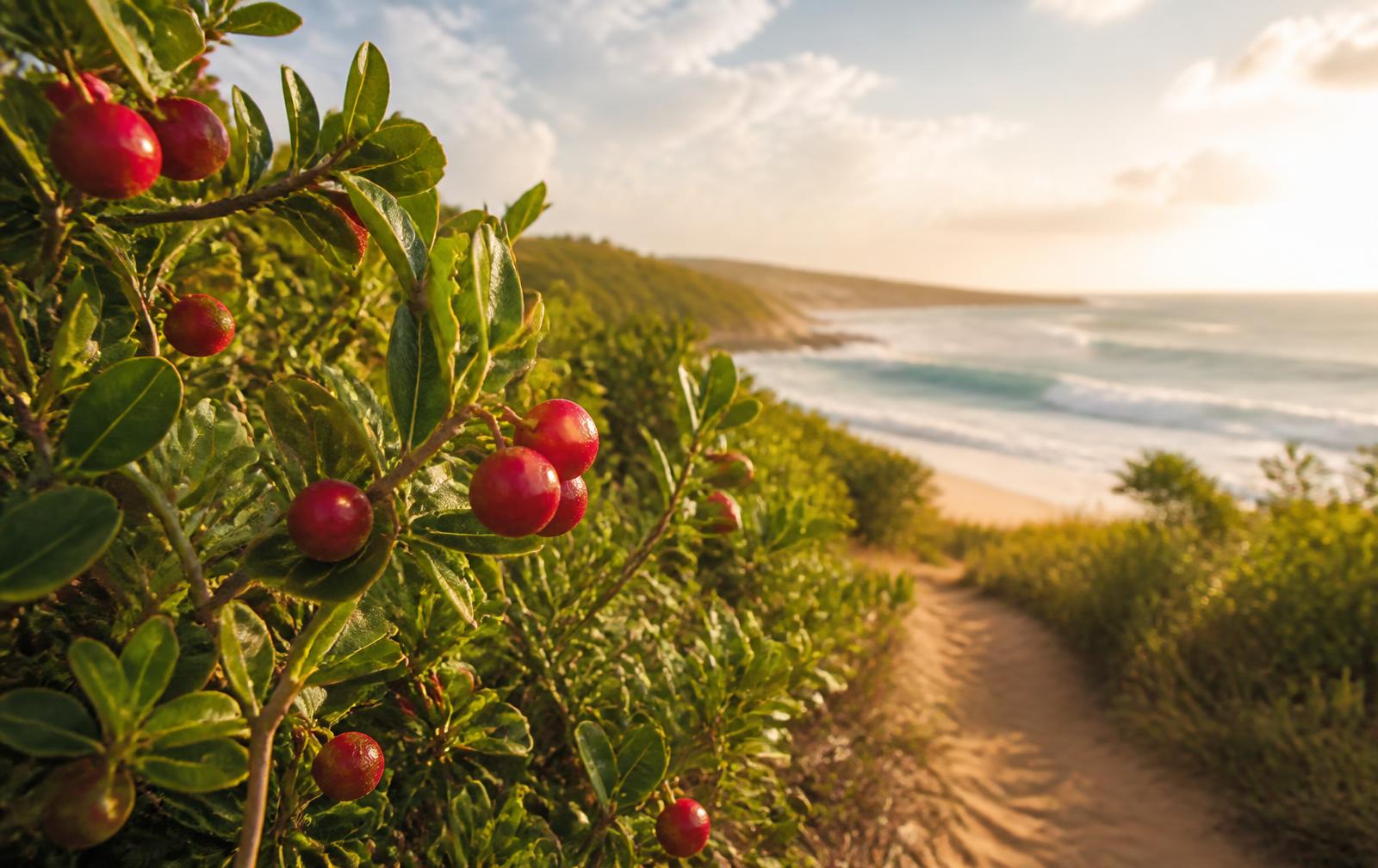
One of my favourite examples in the book is the Natal plum, Carissa macrocarpa.
Known by several names, including Natal plum, big num-num, grootnoem-noem and amatungulu, it is indigenous to the coastal regions of South Africa, including KwaZulu-Natal. It is particularly suited to coastal environments and produces a large red edible fruit.
It is a remarkable plant.
It can grow as a dense, thorny coastal shrub, withstand salty coastal winds and produce beautiful white, fragrant flowers before developing its red fruit. The fruit itself can be eaten fresh and is traditionally suitable for preserves such as jams and jellies.
And yet, for many people, it remains something they walk past.
That fascinated me.
Because imagine if we approached our indigenous ingredients with the same curiosity we give ingredients imported from the other side of the world.
Imagine if an ingredient growing along our own coastline could find its way into contemporary kitchens thousands of kilometres away.
That is where the creative process begins.
Taking something familiar and seeing it differently
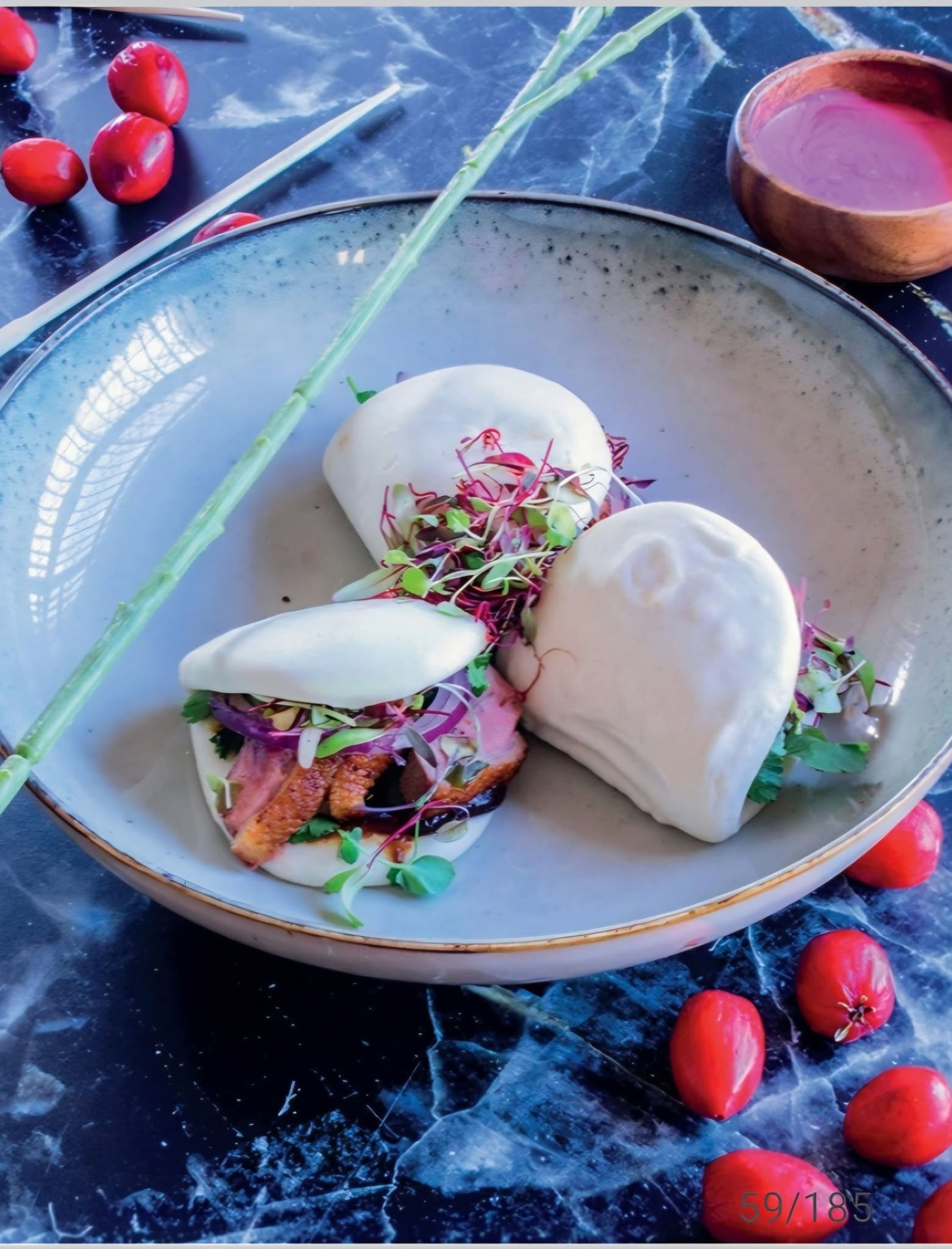
Steamed bao from The Road to Kali*, plated with Natal plum — amatungulu, big num-num, grootnoem-noem — scattered around the dish.*
In The Road to Kali, I created a Natal plum jam, using the fruit to replace the Asian plum element I might traditionally have reached for.
That substitution became more than a recipe experiment.
It became a statement.
Instead of automatically looking elsewhere for an ingredient, what happens if we look at home first?
What happens if we take something that is familiar to our landscape but unfamiliar to the modern culinary conversation and give it a new context?
This is what excites me about cooking.
A recipe does not have to be a museum piece.
It can be a meeting point between the past and the future.
An indigenous ingredient can carry its history while being transformed into something entirely contemporary.
That is not abandoning tradition.
I think it is another way of keeping tradition alive.
The ingredients that deserve a second look
The Natal plum is only one example.
There are countless indigenous and under-utilised ingredients across our continent that deserve greater attention. Some have extraordinary flavours. Others have interesting textures, nutritional qualities or cultural histories. Many have been used locally for generations.
The challenge is that we often value an ingredient more once somebody from somewhere else tells us it is valuable.
I want to reverse that thinking.
We should not have to wait for the rest of the world to discover what has been growing in our own backyard.
There is something powerful about putting an ingredient that has rarely graced the pages of contemporary recipe books into a beautifully photographed dish and saying:
Look at this. This is ours. And look at what it can become.
That is part of what The Road to Kali attempts to do.
The book travels across cultures, but it also keeps returning home.
It takes ideas from places I have travelled, flavours I have encountered and techniques I have learned, and asks what happens when those influences meet the ingredients of my own landscape.
That is where new food can emerge.
Food as a conversation between worlds
I have never believed that cuisine needs to exist inside rigid borders.
South African food itself is evidence of what happens when cultures meet.
Indian. African. Malay. European. Portuguese. Asian.
And countless other influences have found their way into our kitchens and changed what we eat.
My own food is a reflection of that history.
So when I take a South African indigenous fruit and place it into a dish influenced by another part of the world, I am not trying to erase its identity.
I am allowing it to travel.
And perhaps that is the real philosophy behind The Road to Kali.
Take what you inherit. Learn from what you encounter. Then create something of your own.
From the hedge to the table
There is something beautifully democratic about the Natal plum.
It doesn't arrive in an expensive box.
It doesn't need a passport.
It grows.
It flowers.
It produces fruit.
And it waits for somebody to recognise its potential.
That, to me, is the essence of culinary creativity.
Sometimes innovation isn't about finding something nobody has ever seen.
Sometimes it is about seeing something everybody has overlooked.
The next great ingredient may not be exotic.
It may be indigenous.
It may be growing ten minutes from your house.
It may have been known by another name by the people who came before you.
And perhaps it is time we started looking again.
Because The Road to Kali is not only about preserving the food of the past.
It is about asking what we can create from it for the future.
The indigenous ingredients of South Africa deserve to be tasted, understood, celebrated and shared beyond our borders.
And if one reader finishes the book, walks outside, sees a fruit they have passed a thousand times and suddenly asks,
"What could I make with that?"
then perhaps the journey has already begun.
That is the road to Kali.
— The Road to Kali —